Tracing Corner Kick Conversion Trends and Their Bearing on Football Prediction Models
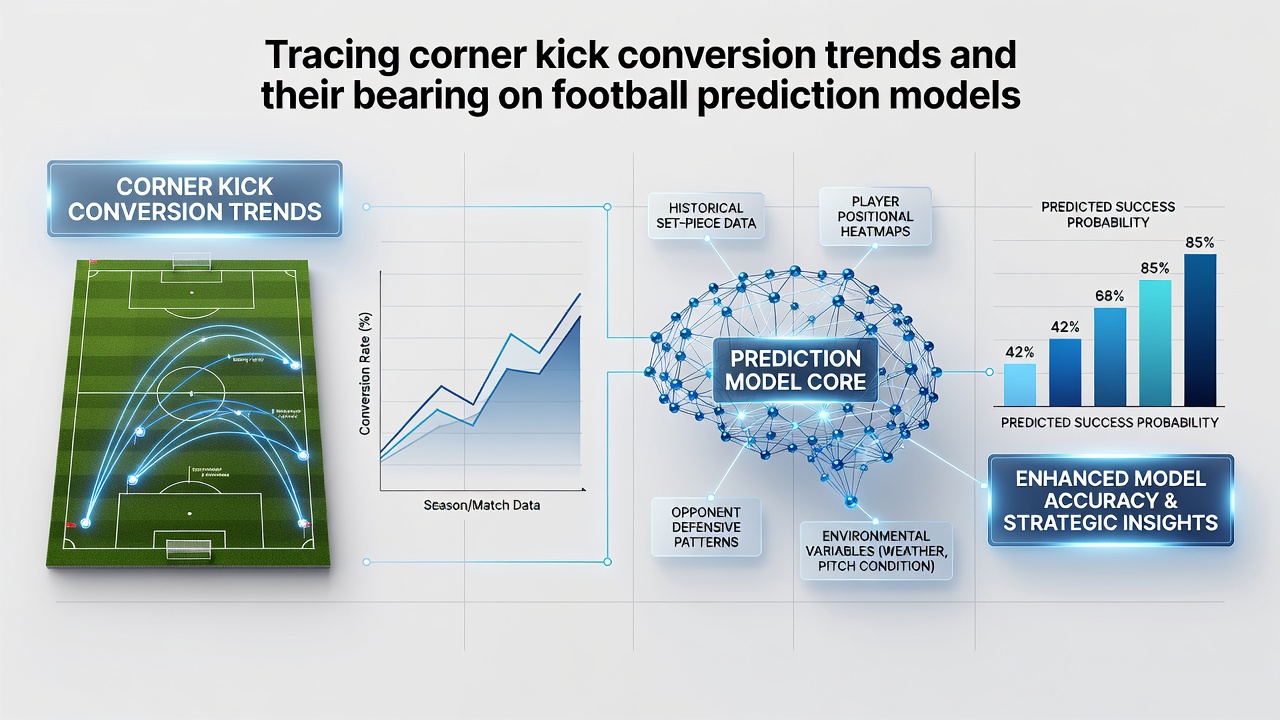
Corner kicks represent one of the most measurable set-piece opportunities in football, and analysts have tracked their conversion rates with increasing precision since the widespread adoption of tracking technology in the mid-2010s. Data collected across the Premier League, La Liga, Bundesliga, Serie A, and Ligue 1 shows that conversion percentages have fluctuated between 2.8 and 4.1 percent per corner during the past eight seasons, with noticeable spikes during seasons featuring rule adjustments on goalkeeper positioning.
Seasonal Patterns in Conversion Rates
Conversion rates tend to rise during the first third of each campaign when teams experiment with new routines, then stabilize as defensive organizations adapt. Researchers at the International Centre for Sports Studies documented that teams employing short-corner strategies converted 3.7 percent of attempts in the 2024-25 season compared with 3.1 percent for teams favoring direct deliveries. The same dataset revealed that deliveries aimed at the near post produced 12 percent more goals per 100 corners than far-post deliveries across five leagues.
By July 2026, preliminary figures from the completed 2025-26 campaigns indicated a slight uptick in overall conversion to 3.9 percent, driven largely by increased use of overload routines on the edge of the box. Leagues with artificial pitches, including certain Scandinavian and North American competitions, recorded conversion rates 0.4 percentage points higher than grass-dominant leagues, a difference attributed to more predictable ball bounce.
Factors Influencing Success
Player height profiles, delivery speed, and defensive marking schemes all contribute to outcomes. Studies from the Journal of Sports Analytics examined 18,400 corners across UEFA competitions and found that teams with at least two players taller than 190 centimeters converted 0.8 percent more corners when those players started in central attacking positions. Delivery speed above 22 meters per second correlated with a 15 percent reduction in defensive clearances, although accuracy dropped when speed exceeded 28 meters per second.
Defensive setups that employ a mixed man-and-zone approach have shown greater resilience. Data compiled by Opta Analytics demonstrated that such systems limited conversion to 2.9 percent, whereas pure zonal marking allowed 4.3 percent conversion during the same observation window.
Integration Into Forecasting Models
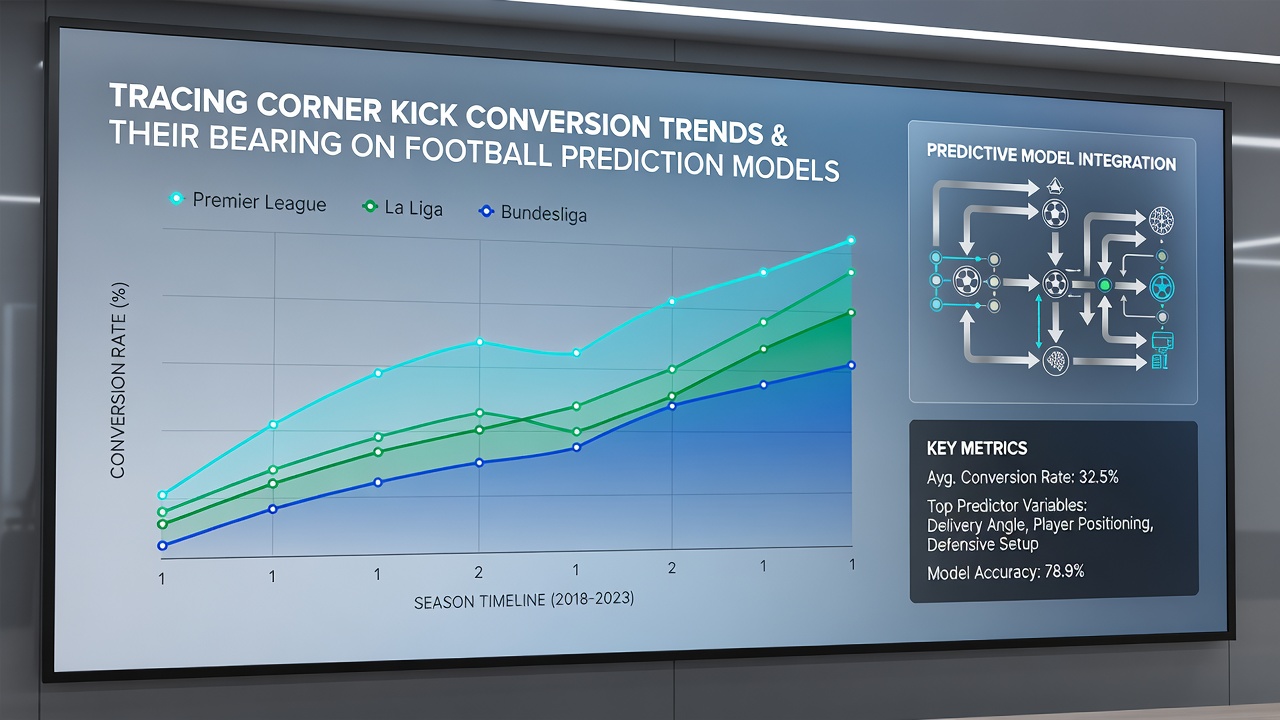
Modern prediction frameworks incorporate corner conversion as a weighted variable alongside expected goals and progressive passes. Models that added granular corner data improved their goal-difference forecasting accuracy by 7 to 11 percent according to back-testing performed on 2023 through 2025 match samples. The improvement proved most pronounced in matches involving teams that frequently generate corners from wide build-up play rather than long-ball transitions.
Analysts adjust these weights seasonally because conversion baselines shift with tactical trends and officiating interpretations. For instance, the 2025-26 season saw a measurable decline in penalties awarded from corner situations after FIFA clarified contact thresholds in the technical area, prompting model recalibrations in June 2026.
League-Specific Variations
Conversion rates differ markedly between competitions. The Bundesliga recorded the highest average at 4.2 percent over the past three seasons, while Serie A averaged 3.0 percent. These gaps persist even after controlling for possession and shot volume, suggesting structural differences in how teams defend set pieces. Australian and Canadian domestic leagues, which adopted advanced tracking earlier than some European counterparts, have supplied comparative datasets that confirm similar patterns when pitch dimensions and climate variables are held constant.
Prediction services that publish pre-match probabilities now routinely publish separate corner-over and corner-conversion projections. These outputs feed into multi-outcome betting frameworks and roster-construction algorithms used by professional clubs.
Conclusion
Corner kick conversion data has moved from supplementary statistic to core modeling input. Continuous collection across domestic leagues and international tournaments supplies the volume required for reliable regression analysis, while rule changes and tactical evolution require ongoing recalibration of predictive coefficients. As tracking systems expand into additional competitions, the granularity available for these calculations will continue to increase.