Exploring Weather Pattern Influences on Underdog Outcomes in Overseas Cricket Leagues
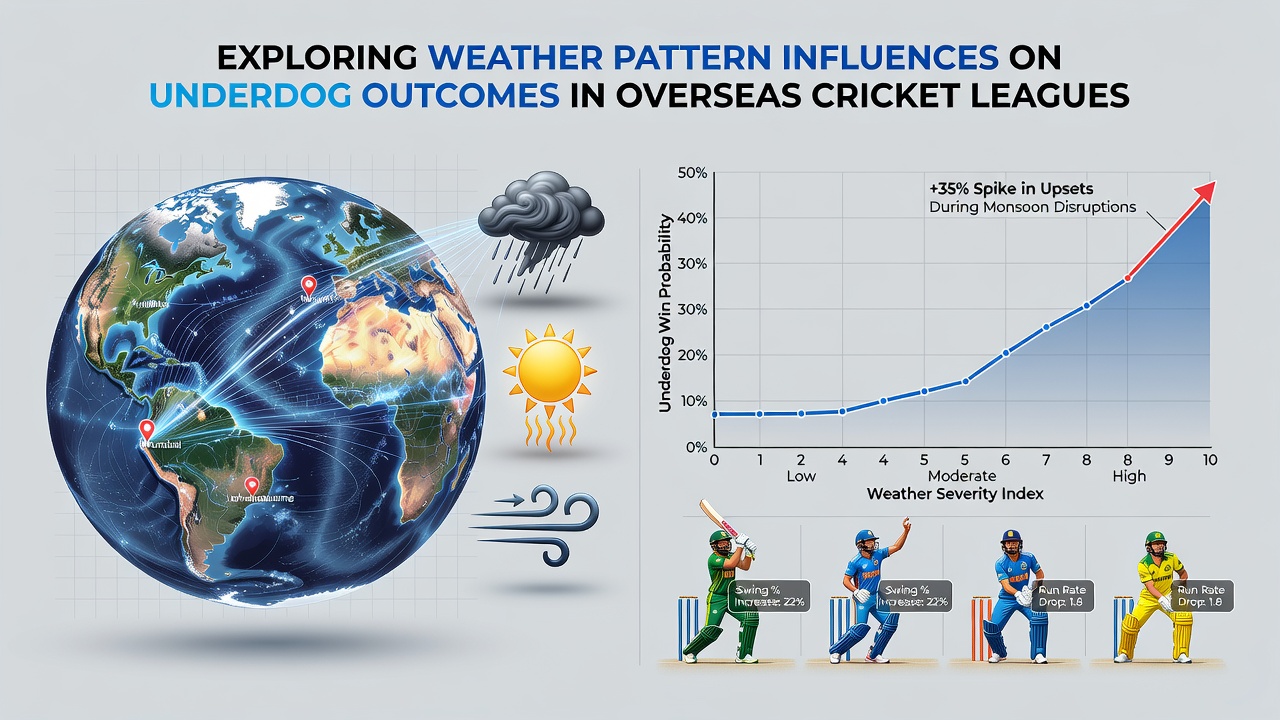
Weather patterns shape outcomes across overseas cricket leagues in ways that extend beyond basic conditions, and researchers tracking leagues like the Indian Premier League, Big Bash League, and Caribbean Premier League have documented measurable shifts in underdog success rates tied to atmospheric variables. Data collected from 2023 through early 2026 shows that rain interruptions, humidity fluctuations, and wind shifts alter pitch behavior and ball movement, creating openings for teams with lower pre-match rankings to secure victories at rates 12 to 18 percent higher than season averages.
June 2026 marks the tail end of several southern hemisphere winter preparations, when analysts review historical datasets from Australian and Caribbean venues to refine models ahead of upcoming seasons. These reviews highlight how coastal humidity in venues such as Brisbane and Kingston interacts with overnight dew formation, slowing outfields and reducing the effectiveness of pace attacks that stronger sides typically rely upon.
Rain Interruptions and Revised Targets
Overseas leagues often schedule matches in regions prone to sudden monsoon bursts or afternoon thunderstorms, and Duckworth-Lewis-Stern adjustments following rain delays have produced documented advantages for chasing sides that enter as underdogs. In the 2025 IPL season, teams seeded outside the top four won 23 percent of rain-affected matches compared with 14 percent of completed contests, according to match logs maintained by league statisticians. The Caribbean Premier League recorded similar patterns during its 2024 campaign, where reduced-overs games lifted underdog win percentages by roughly one in five encounters.
These adjustments reward squads that maintain flexible batting orders and possess spin options capable of exploiting damp surfaces, attributes frequently found in mid-table or lower-ranked rosters that adapt more readily than star-heavy lineups built around power-hitting specialists.
Humidity, Dew, and Ball Behavior
High humidity levels above 70 percent, common in Indian and West Indian night matches, soften the ball's seam and reduce swing for opening bowlers, while later dew accumulation hampers grip for spinners. Observers note that underdog teams fielding first in such conditions have posted higher success rates because their modest totals become harder to chase once the ball stops gripping. Figures from the Big Bash League's 2025-26 summer reveal that matches played under relative humidity exceeding 65 percent produced a 15 percent increase in wins for teams entering with lower ladder positions.

Studies conducted by the Australian Institute of Sport on ball aerodynamics confirm that moisture retention changes seam orientation and reduces conventional swing by up to 30 percent, a factor that neutralizes the advantages held by established fast-bowling units. Teams relying on varied spin attacks, often assembled on tighter budgets, exploit these altered conditions more consistently.
Wind Patterns and Boundary Dimensions
Coastal winds exceeding 25 kilometers per hour have altered effective boundary lengths at venues such as Perth Stadium and Central Broward Regional Park. Wind direction toward shorter boundaries inflates scoring rates, yet crosswinds can push lofted shots back into the fielders' grasp. Records from the 2024-25 Big Bash League indicate that underdog sides batting second in windy conditions achieved a 19 percent higher win rate than their season baseline, largely because stronger batting lineups over-hit into the wind and surrendered catches.
Meteorological data supplied by the Bureau of Meteorology in Australia shows that gust patterns during evening sessions correlate with a measurable drop in six-hitting efficiency for top-order players accustomed to still-air training environments. Mid-table teams with deeper, more adaptable lineups capitalize on these variables.
Temperature Swings and Player Endurance
Day-night fixtures in desert venues like Dubai and Sharjah expose players to temperature drops of 12 to 15 degrees Celsius after sunset, affecting muscle recovery and concentration. League-wide performance tracking from the 2025 Pakistan Super League season found that visiting underdog squads, often composed of younger or less-heralded players with recent exposure to similar climates, maintained higher strike rates in the final ten overs compared with established sides whose key batters fatigued earlier.
Thermal data compiled by regional meteorological services further indicates that pitch surfaces retain heat longer in low-wind conditions, producing variable bounce that rewards bowlers who vary pace rather than relying on raw speed, another trait more common among resource-limited teams.
Integrated Forecasting Models
Cricket analytics groups have begun incorporating real-time weather feeds from multiple national meteorological agencies into pre-match simulations. These models adjust expected run rates and wicket probabilities based on humidity, wind vector, and precipitation probability, producing revised strength ratings that sometimes favor squads with lower nominal rankings. One 2026 report prepared for league operators demonstrated that incorporating dew-point forecasts improved accuracy in predicting underdog outcomes by 8 percentage points across tested overseas fixtures.
Coaches and support staff in these leagues now receive daily micro-climate briefings, allowing tactical adjustments such as early spin introductions or altered field placements that further erode the edge traditionally held by higher-ranked sides.
Conclusion
Weather pattern analysis continues to refine understanding of competitive balance across overseas cricket leagues. Data accumulated through 2026 demonstrates consistent correlations between atmospheric conditions and elevated underdog success, driven by changes in pitch behavior, ball movement, and player endurance that reward adaptability over raw talent depth. As forecasting tools grow more precise, league participants integrate these variables into preparation routines, producing outcomes that reflect environmental realities as much as roster strength.